
What does Belief 16 say about the Lord's Supper?
The voted statement calls Communion a sharing in the emblems of Jesus' body and blood, prepared for by foot-washing, and open to all believing Christians.
In this article
1. Issue framed
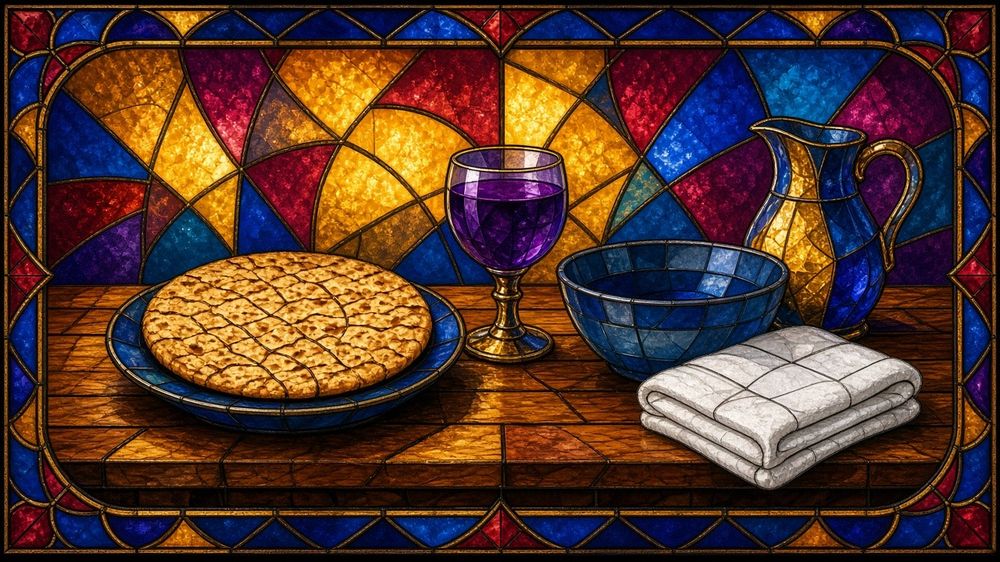
Belief 16, "The Lord's Supper," sits just after the article on baptism. It asks what the Communion service is, how believers are to prepare for it, and who may take part. The voted statement answers by calling the Supper a participation in the emblems of Jesus' body and blood, by naming foot-washing as the preparation Christ ordained, and by saying the service "is open to all believing Christians."
2. Documented positions in view
The voted wording. The current Fundamental Beliefs state: "The Lord's Supper is a participation in the emblems of the body and blood of Jesus as an expression of faith in Him, our Lord and Saviour. In this experience of communion Christ is present to meet and strengthen His people. As we partake, we joyfully proclaim the Lord's death until He comes again. Preparation for the Supper includes self-examination, repentance, and confession. The Master ordained the service of foot-washing to signify renewed cleansing, to express a willingness to serve one another in Christlike humility, and to unite our hearts in love. The communion service is open to all believing Christians." The same wording appears in the 2025 Church Manual, 21st edition, and on the church's official Belief 16 page.
How it follows Belief 15. Belief 15 says that by baptism believers "acknowledge Christ as Lord and Saviour, become His people, and are received as members by His church." Belief 16 then describes the table to which believing Christians come: a service of remembrance and proclamation, prepared for by self-examination and by foot-washing, "open to all believing Christians."
The 2025 Church Manual. The Manual, official teaching revised only at a General Conference Session, says the communion service "customarily is celebrated once per quarter" and that "The service includes the ordinance of foot-washing followed by the Lord's Supper." It calls the bread and cup "symbols representing His body and His blood," and it says that "only unfermented grape juice and unleavened bread are appropriate." Under the heading "Who May Participate," it says: "The Church practices open communion. All who have committed their lives to the Savior may participate."
The official explainer. The church's Belief 16 page says, "Seventh-day Adventists practice open communion. All believers who claim Jesus is their Lord are welcome to take part in the service." It describes the bread and the cup as symbols, and it calls the foot-washing "the 'ordinance of humility.'" This is official website teaching, not a second Session vote.
Ellen White, in original books. In The Desire of Ages (1898), chapter 71, "A Servant of Servants," she wrote, "Christ was here instituting a religious service," and: "This ordinance is Christ's appointed preparation for the sacramental service." In chapter 72, "In Remembrance of Me," she wrote: "The Passover wine, untouched by fermentation, is on the table. These emblems Christ employs to represent His own unblemished sacrifice." On who may come, she said: "Christ's example forbids exclusiveness at the Lord's Supper. It is true that open sin excludes the guilty. ... But beyond this none are to pass judgment." And: "It is at these, His own appointments, that Christ meets His people, and energizes them by His presence."
3. Scriptural arguments attributed and compared
The belief lists these texts, quoted here from the King James Version.
In Matthew 26, during the Passover meal, "Jesus took bread, and blessed it, and brake it, and gave it to the disciples, and said, Take, eat; this is my body. And he took the cup, and gave thanks, and gave it to them, saying, Drink ye all of it; For this is my blood of the new testament, which is shed for many for the remission of sins" (Matthew 26:26-28).
In John 13, Jesus "poureth water into a bason, and began to wash the disciples' feet," and said, "If I then, your Lord and Master, have washed your feet; ye also ought to wash one another's feet. For I have given you an example, that ye should do as I have done to you" (John 13:5, 14, 15).
John 6 records an earlier talk in Capernaum, not the supper itself. Jesus says, "I am that bread of life," and that "the bread that I will give is my flesh, which I will give for the life of the world" (John 6:48, 51). When some stumble at the saying, He adds, "It is the spirit that quickeneth; the flesh profiteth nothing: the words that I speak unto you, they are spirit, and they are life" (John 6:63).
Paul writes, "The cup of blessing which we bless, is it not the communion of the blood of Christ? The bread which we break, is it not the communion of the body of Christ?" (1 Corinthians 10:16). "For we being many are one bread, and one body: for we are all partakers of that one bread" (1 Corinthians 10:17). He says, "For as often as ye eat this bread, and drink this cup, ye do shew the Lord's death till he come," and, "But let a man examine himself, and so let him eat of that bread, and drink of that cup" (1 Corinthians 11:26, 28). Revelation 3:20, spoken to a church, says, "Behold, I stand at the door, and knock: if any man hear my voice, and open the door, I will come in to him, and will sup with him, and he with me."
On the official list these passages do not pull against one another. Matthew 26 and 1 Corinthians 11 institute the bread and the cup as a remembrance and a proclamation of His death until He comes. John 13 gives the example of foot-washing, John 6 speaks of living by Christ, the bread of life, and Revelation 3:20 pictures Christ coming in to sup with the one who opens the door.
4. Historical and teaching context
The wording quoted above is the current voted statement, reprinted in the 2025 Church Manual as Belief 16. The Manual's "Communion Service" chapter applies that statement as official teaching, including open communion, foot-washing, and the use of unleavened bread and unfermented grape juice. The Belief 16 page then explains the voted text; those explanations help readers, but they are not themselves a Session action. Ellen White's books were written earlier and are not Session votes, but the pages cited above move in the same direction.
5. Agreements and disagreements
These sources present compatible emphases, not rival official definitions of the belief. The voted article, the 2025 Manual, the official explainer, and the original books cited above all describe the bread and the cup as emblems, or symbols, of Jesus' body and blood; all treat foot-washing as the preparation Christ gave; and all present the service as open to believing Christians, with self-examination, though the Manual and Ellen White both say open sin is a barrier.
The statement also holds more than one claim at once: the emblems express faith; Christ is present; His death is proclaimed until He comes; and the table is open to all believing Christians. How congregations hold those claims together is a question the article does not settle case by case.
6. Implications and uncertainties
If the statement is read as it stands, the bread and cup are emblems of Jesus' body and blood, taken in faith, and the service is open to all believing Christians. Foot-washing is part of the preparation Christ ordained, along with self-examination, repentance, and confession. The official page and the Manual both call this open communion. The 2025 Manual, as official teaching, describes a customary quarterly service and notes that children are prepared to partake after baptism.
7. Limits — no doctrinal ruling
This examination issues no final doctrinal ruling.
Tip: press and hold any sentence to flag it as unclear.Tip: select any sentence to flag it as unclear.
Comments (0)
No comments yet. Be the first.
Thank you. Your comment will appear shortly after review.
Read next

What does Belief 15 say about baptism?
The voted statement calls baptism a confession of faith in Jesus' death and resurrection, done by immersion, for people who believe, repent, and have been instructed in the Scriptures.
 MaraTheology

What does Belief 12 say the church is?
The voted statement calls the church a community of people who confess Jesus as Lord, and that article sits between the beliefs about salvation and the beliefs about the remnant and unity.
MaraTheology